Posts

Showing posts with the label Spring 2018

Second Helpings

Image
For this Action Project for our Food For Thought class, we were asked to make two versions of the same meal, one home-made, one store-bought. During this final term of our Humanities class, we went on several FEs. One went to Uncommon Ground, a restaurant with a garden on their rooftop. Below is my paper on my experience of this Action Project, along with images of the food that I cooked. WH; Ingredients for homemade meatloaf; 2018 WH, Homemade meatloaf, 2018 WH, Store-bought meatloaf, 2018 WH, Store-Bought Meatloaf, 2018 In conclusion, I thought that this Action Project was a tough action project, but I think I managed to finish it up pretty well. I liked this action project, it gave us a chance to cook something in our own home.

G. M. (n)O.

Image
This is our final action project for our STEAM Food class. For this unit of our Food class, we learned more about how GMOs have affected farming and the science behind GMOs. For this AP, we were asked to make a slideshow, as well as a video presenting the slideshow, about GMOs. We could choose to be either pro-GMO or anti-GMO. Below is my video on the topic, and the slideshow that goes along with it. In conclusion, I thought that this Action Project was a tough project to get done, especially with the limited amount of time that we had to do it with, but I managed to pull through and finish it up. It was interesting to learn about an important issue like GMOs.

The More We Grow, The Harder We Fall

Image
 For the second unit of my Food for Thought Humanities class, Death, we learned more about the history of food. We went on a Field Experience to the Lincoln Park Conservatory, and we learned more about the diversity of plants and polycultures and monocultures. For this Action Project, we were asked to write a paper, and then make a video on it. Below is my video, and my paper. Global population is a growing problem. The global food system is the system that keeps the world fed. It encompasses global food trade routes, agriculture, shipping, among other things. It’s threatened by a growing population because we can’t grow enough food and supply it fast enough if our population grows out of control. Population growth is a, well, growing problem, and we need to find solutions for it as soon as we possibly can. If policies stay the way they are now, civilization very well could collapse before we even get to 2050. Population growth is quickly becoming a big problem. We aren...

Rise and Shine!

In the 2nd unit of my Food STEAM class, we learned more about how to cook, and how cooking affects all of us. For this Action Project, we were asked to bake loaves of bread, with different recipes and leavening agents for each loaf. Below is my lab report for this project, and for my group's loaf of bread. In conclusion, I thought that this was a pretty tough project, although most of it was done in-class. Getting the calculations and the conclusion done was quite difficult, but I think I did well on the project overall.

Solanum tuberosum. Or, rather, a potato.

Image
In this first unit for Food For Thought, we learned about the history of food, and how food has traveled across the world. For this Action Project, we were asked to take on the persona of a food from our families' history, and write an autobiography of sorts about it. I chose the potato. Below is the audio for my autobiography, as well as the presentation that goes along with it. I am the humble potato. Today, I am the 5th most important crop worldwide. I originated in South Peru, in the Andes Mountains. I was first domesticated by the pre-Inca people of the Andes about 8,000 years ago. I was an originally toxic plant, but over time Andean and European humans domesticated me so that I became harmless. The first Spaniards in the region—the group led by Francisco Pizarro, who landed in 1532—noticed Indians eating these strange, round objects and emulated them, often reluctantly. Within three decades, Spanish farmers as far away as the Canary Islands were exporting me to Franc...

A One-Garden Revolution

Image
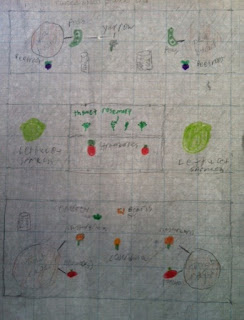
In my Food class for STEAM, we learned about gardening during this first unit. For this action project, we were asked to create our own dream, or hypothetical (we aren't actually going to plant it) garden. The garden that I will create will be in my own backyard, close to the garage out back. It will be 7 feet by 9 feet, or 63 square feet (my walking paths are 14 square feet each). The original soil quality was not the best, so I added Sulfate of Potash, Fish Meal, and Soft Rock Phosphate to control the nitrogen, potassium, and phosphorus levels in the soil. For my plants, I chose beans, strawberries, comfrey, tomatoes, spinach, peas, beetroot, calendula, lettuce, rosemary, thyme, yarrow, and nasturtium. This is related to symbiosis because these plants will grow well together, because they have evolved to benefit each other. For example, nasturtium improves the taste of tomatoes, and calendula wards away tomato worms. WH, 2018, My Garden Plan I am going to be inspired by...

It's Not Exactly Rocket Science

In our STEAM class Rocket Science, we learned about the math and science behind rocket science, albeit at a 9th-10th grade level. We built and launched our own water bottle rockets.